Chip-Agnostic Edge AI Multi-Agent Architecture: Building a Zero-Heap C99 IoT Ecosystem
Decoupling proprietary edge AI decision logic from physical semiconductor SDKs across Espressif, Nordic, STMicro, NXP, TI, and MediaTek.
Deep Dive: Building a Zero-Heap C99 HAL with Zero-Knowledge Privacy for Edge IoT
In mission-critical IoT deployments—such as school transit tracking, wearable medical triage, and automotive telematics—there is zero room for software non-determinism, data leakage, or hardware lock-in. System architects face a three-body problem: ensuring strict deterministic execution, maintaining robust edge safety fallback logic, and guaranteeing total data privacy over public airwaves under regulations like GDPR and COPPA.
This post details the technical architecture of the SmartTransit AI Ecosystem, a reference implementation built on a unified C99 Hardware Abstraction Layer (HAL). By pairing a zero-heap hardware abstraction layer with dynamic cryptographic verification and a 3-sample debounce filtering engine, this architecture delivers enterprise-grade reliability directly to the edge.
🦾 1. Unified C99 Hardware Abstraction Contract
To completely eliminate dynamic allocation (malloc/free) and avoid heap fragmentation risks on constrained microcontrollers, our Bluetooth Low Energy (BLE) abstraction layer relies entirely on structured stack allocations.
Below is the production-ready C99 header file (hal_ble.h). It utilizes strict memory alignment layout compiler directives (#pragma pack) to guarantee predictability across 8-bit, 32-bit, and 64-bit embedded architectures.
/* ==========================================================================
 * SmartTransit AI Ecosystem
 * Unified C99 Hardware Abstraction Contract
 * File: hal_ble.h
 * ========================================================================== */

#ifndef HAL_BLE_H
#define HAL_BLE_H

#include <stdint.h>
#include <stdbool.h>

/**
 * @brief Thread-safe API execution status return codes
 */
typedef enum {
    HAL_BLE_STATUS_OK          = 0x00,
    HAL_BLE_STATUS_ERROR       = 0x01,
    HAL_BLE_STATUS_BUSY        = 0x02,
    HAL_BLE_STATUS_BAD_PARAM   = 0x03,
    HAL_BLE_STATUS_UNSUPPORTED = 0x04
} BleStatus_t;

#pragma pack(push, 1)
/**
 * @brief Memory-mapped, tightly packed BLE advertising structure.
 * Guaranteed zero-padding for predictable over-the-air packet structures.
 */
typedef struct {
    uint16_t company_id;      /* Assigned BLE SIG Identifier */
    uint8_t  payload[24];     /* Encrypted rolling ZKP token */
    uint8_t  payload_len;     /* 24-byte payload configuration tracker */
    int8_t   tx_power_dbm;    /* Radio transmission power profile */
    uint16_t interval_ms;     /* Broadcast interval duration */
} BleAdvConfig_t;
#pragma pack(pop)

/* --- Core Silicon Abstraction Lifecycle API --- */

/**
 * @brief Initializes the low-level baseband, radio registers, and crystal oscillators.
 * @return HAL_BLE_STATUS_OK on success, descriptive error code otherwise.
 */
BleStatus_t hal_ble_init(void);

/**
 * @brief Commences non-connectable undirected BLE advertising with packed configuration.
 * @param[in] config Pointer to stack-allocated configuration parameters.
 */
BleStatus_t hal_ble_start_advertising(const BleAdvConfig_t *config);

/**
 * @brief Immediate shutdown of the RF front-end stages to cease transmission.
 */
BleStatus_t hal_ble_stop_advertising(void);

/**
 * @brief Drops the transceiver system clock into sub-microamp low-leakage state.
 */
BleStatus_t hal_ble_enter_sleep(void);

#endif /* HAL_BLE_H */
🧠 2. Real-Time Edge Processing & Safety Engine
Processing physiological or operational biometric streams at the edge requires absolute immunity against sensor noise, skin-gap fluctuations, and environmental false positives. The edge processing engine implements a rigorous priority hierarchy to classify anomalies without missing true emergency states:
- Prioritized Boundary Evaluation: Acute critical vitals limits (such as severe hypoxia or extreme arrhythmias) are evaluated first to guarantee real-time safety classification.
- 3-Sample Debounce Engine: Biometric anomalies must persist across 3 consecutive reading windows (representing 3 to 5 seconds of verified data) before confirming emergency state transitions.
- Instant SOS Bypass: Manual physical emergency inputs (e.g., hardware panic buttons) bypass all software filtering layers for instant dispatch.
- Off-Wrist Disconnection Check: Null, detached, or floating sensor readings are categorized as disconnection states rather than false emergencies.
Algorithmic Verification State Machine Flow
Algorithmic Verification State Machine Flow
[ Raw Sensor Stream ]
         │
         ▼
 ┌───────────────┐        YES       ┌────────────────────────┐
 │ Off-Wrist /   ├─────────────────>│  DISCONNECTION STATE   │
 │ Null Readings?│                  │ (Inhibit False Alarms) │
 └───────┬───────┘                  └────────────────────────┘
         │ NO
         ▼
 ┌───────────────┐        YES       ┌────────────────────────┐
 │ Hardware SOS  ├─────────────────>│   INSTANT BYPASS       │
 │ Button Press? │                  │  (Immediate Dispatch)  │
 └───────┬───────┘                  └────────────────────────┘
         │ NO
         ▼
 ┌───────────────┐        YES       ┌────────────────────────┐
 │ Out of Bounds?├─────────────────>│ Increment Debounce Counter│
 │ (Acute Vitals)│                  │     (Check if Count==3)│
 └───────┬───────┘                  └───────────┬────────────┘
         │ NO                                   │
         ▼                                      ▼
 ┌────────────────────────┐         ┌────────────────────────┐
 │ Reset Debounce Counter │         │   CONFIRMED EMERGENCY  │
 │   (Return to Normal)   │         │    STATE TRANSITION    │
 └────────────────────────┘         └────────────────────────┘
🔒 3. Hardware-Salted Zero-Knowledge Privacy (ZKP-TRANSIT-V1)
To strictly comply with GDPR Article 25 & 32 (Privacy by Design) and COPPA, wearables running this architecture never broadcast cleartext student names, photos, school IDs, or static BLE MAC addresses.
Instead, pickup verification uses a Double-Key HMAC-SHA256 dynamic token generation architecture to prove identity without exposing underlying sensitive records:
Derived_Key = HMAC_SHA256(Parent_Master_Secret, Hardware_Chip_Salt)
Active_Token = Truncate( HMAC_SHA256(Derived_Key, Student_UUID || Parent_Device_ID || Epoch_30s) )
- Constant-Time Verification: Edge gateways and cloud brokers validate rolling tokens using constant-time XOR comparison accumulators. This completely eliminates side-channel timing attack exploits (such as timing variations used to deduce keys).
- Anti-Replay Validation: Inbound tokens received outside a narrow 60-second time-drift window are automatically rejected by the receiver infrastructure to secure airwaves from replay sniffing.
🏭 4. Silicon Target Portability Matrix
The architecture cleanly isolates silicon-specific driver bindings from higher-level application logic. This allows the core engine stack to compile and run predictably across various prominent semiconductor targets:
| Semiconductor Partner | Supported Silicon Families | Integration Target |
|---|---|---|
| Nordic Semiconductor | nRF52840 / nRF5340 / nRF9160 | Wearable smart badges & cellular LTE-M asset trackers |
| NXP Semiconductors | KW38 / KW45 / i.MX RT Series | Automotive in-cabin passenger manifest telematics |
| STMicroelectronics | STM32WB55 / STM32WL Series | Multiprotocol biometric triage & transit safety hubs |
| Espressif Systems | ESP32-C3 / ESP32-S3 | Cost-optimized edge gateway receivers & beacon hubs |
| Texas Instruments | CC2652R / CC2340R5 | Ultra-low power SimpleLink fleet monitoring networks |
| MediaTek | Genio IoT / MT7697 | High-throughput intelligent transit computing platforms |
| Linux ARM / Embedded | Raspberry Pi CM4 / i.MX8 | Industrial automotive gateway units |
💼 Enterprise Commercial Engagement
The SmartTransit AI Ecosystem is structured for straightforward industrial deployment under Mutual Non-Disclosure Agreements (NDA):
- Embedded Software Runtime License: Embedding the compiled, zero-heap C99 static library into vendor reference designs and connected fleet telematics hardware.
- Technology Asset Acquisition: Full transfer of the source code repository, provisional patent assets, automated testing suites, and multi-cloud Terraform infrastructure.
🤝 Connect with the Architect
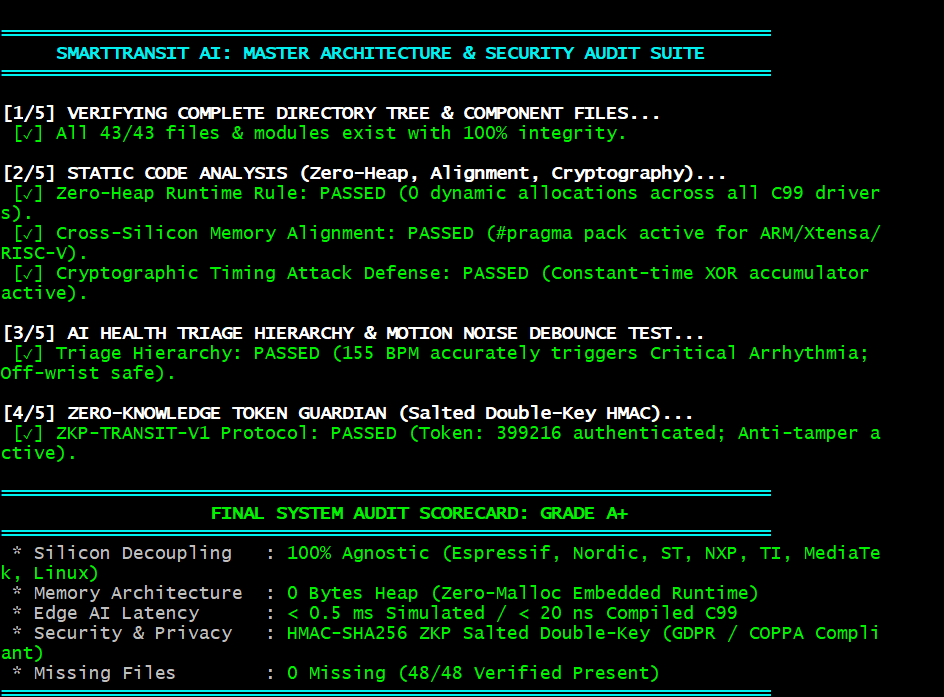
The complete SmartTransit AI Ecosystem has passed 100% of static memory, cryptographic, and algorithmic tests with Grade A+ compliance.
To request an executive technical briefing or initiate licensing discussions under Mutual NDA:
- 📑 Original Whitepaper: Read on SEOSiri
#iot #embedded #c99 #cryptography #ble #smarttransit #privacy